Sunday, August 1, 2010

One Book - One Lincoln Books

One Book – One Lincoln

Past Finalists and Selected Titles

2009

People of the Book by Geraldine Brooks

What is the What by Dave Eggers

The Widow of the South by Robert Hicks

The Color of Water by James McBride [305.8 McB]

The River of Doubt by Candice Millard [Biography Roosevelt]

2008

Double Bind by Chris Bohjalian

The Memory of Running by Ron McLarty

Three Cups of Tea by Greg Mortenson [915.491 Mor]

The Thirteenth Tale by Diane Setterfield

The Book Thief by Markus Zusak

2007

Moloka’i by Alan Brennert

The Madonnas of Leningrad by Debra Dean

The Worst Hard Time: The Untold Story of Those Who Survived the Great American Dust Bowl by Timothy Egan [973.917 Ega]

Water for Elephants by Sara Gruen

If Nobody Speaks of Remarkable Things by Jon McGregor

2006

Broken for You by Stephanie Kallos [Nebraska Author]

Prodigal Summer by Barbara Kingsolver

The Devil in the White City by Erik Larson [364.152 Lar]

Crow Lake by Mary Lawson

The Glass Castle: A Memoir by Jeanette Walls [B W1547]

2005

The Kite Runner by Khaled Hosseini

The Green Mile by Stephen King

Local Wonders: Seasons in the Bohemian Alps by Ted Kooser [917.823 Koo] [Nebraska Author]

Life of Pi by Yann Martel

The Things They Carried by Tim O’Brien

2004

Peace Like a River by Leif Enger

Five Quarters of the Orange by Joanne Harris

The Secret Life of Bees by Sue Monk Kidd

Cry the Beloved Country by Alan Paton

Old Jules by Mari Sandoz [B Sa54s] [Nebraska Author]

2003

The Weight of Dreams by Jonis Agee [Nebraska Author]

Fried Green Tomatoes at the Whistle Stop Café by Fannie Flagg

Bel Canto by Ann Patchett

Empire Falls by Richard Russo

Angle of Repose by Wallace Stegner

2002

A Lesson Before Dying by Ernest J. Gaines

Snow Falling on Cedars by David Guterson

Plainsong by Kent Haruf [Nebraska Author]

Last Days of Summer by Steve Kluger

Montana 1948 by Lawrence Watson

– indicates the selected title for this year

Friday, June 25, 2010

The Color of Water: A Black Man's Tribute to His White Mother - James McBride

This is a biography about the author's mother, Ruth McBride Jordan (born Ruchel Dwajra Zylska, raised Rachel Deborah Shilsky). She was born in Poland in 1921, and two years later her small family (father, mother, and younger sister) immigrated to the United States, settling in Virginia.

Her family was Jewish, and her father was sort of a Rabbi. He, however, was abusive to her as well as to her mother. She was white, and began dating an African American young man when she was a teenager. Through various difficulties, their relationship fell apart.

Over the years, her mother sent her away each summer to live with her mother's family in New York City. Only her grandmother really ever accepted her.

When she graduated from high school, she moved to New York City. A few years later her mother was admitted to a hospital in NYC, but Ruth was not allowed to visit because she was considered "dead" to the family who had already performed her Jewish death rites, by reciting the kaddish and sitting shiva for her.

During her time in NYC, she mete and fell in love with Dennis McBride, an African American man. They lived in a few very small apartments together, and had 8 children. During that time, Dennis also went to school and became a preacher, and they started their own church out of their home. They moved this church twice as it grew.

When Ruth was pregnant with their 8th child (the author of this book), Dennis died of lung cancer without a penny to his name. Ruth had lived the previous 15 years in African American neighborhoods with Dennis (who she insisted marry her when she converted to Christianity), and being accepted more than she ever was among her white peers. In fact, even before she met Dennis she hung out more in Harlem than anywhere else.

Awhile later she met another man, Mr. Jordan, who was older than her, and he asked to take her to a movie. She told him she liked to go to movies and so did her 8 children. He immediately stepped into their lives and cared for them as well as their biological father had. They had 4 more children together.

None of her 12 children knew anything about her past, but James became very interested when he realized she was white but he had never met any of his white family.

She would push aside his questions about her skin color and her past. Eventually, as an adult (and over many years) he pieced together her story and even brought her back to Virginia for the first time to see her only childhood friend.

Amazingly, Ruth's 12 children all graduated from college, many of them with graduate degrees. She always stressed the importance of Jesus Christ and school, which somehow helped every one of them find success.

The title of the book comes from a conversation James often had with his mother:

"When I asked her where she was from, she would say, 'God made me,' and change the subject. When I asked her if she was white, she'd say, 'No. I'm light-skinned,' and change the subject again."

Then he would ask her what color God is, and she would tell him, "The color of water."

Sunday, June 13, 2010

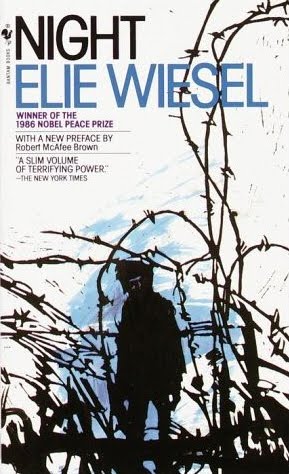
Night - Elie Wiesel


Night is a simple, straightforward memoir of Elie's experiences during WWII. He grew up in Hungary, and relates his experiences relating to the Nazi invasion, and his family and neighbors being forcefully relocated first to the ghetto, and then to various concentration camps.

His story, like all stories from the Holocaust, is tragic and inspiring at the same time. He and his father are separated from his mother and sister early on, and he expresses that the two are each other's strength through the remainder of their experiences.

This is a short (just over 100 pages) book describing more factually than in detail what millions experienced in the 1940s.

Thursday, June 10, 2010

The Guernsey Literary and Potato Peel Pie Society - Mary Ann Shaffer & Annie Barrows

What a perfectly delightful and clever story. This one was recommended to me by several people, but I finally picked it up from the library when my mom (who knows my reading tastes quite well) told me I would love it.

There are many stories which I enjoy reading once, and then they are quickly gone from my life, making only a small impact. Actually, that is why I started this blog - I can't remember much about the books I read unless I discuss them with someone. Since I haven't had time for a book club in the last couple of years, I decided to record my readings here. I digress.

The Guersey Literary and Potato Peel Pie Society will be one of the few books I want to read over again through the years. The language, oh the language! I am such a sucker for beautiful words and sentimental phrasing. This book has both.

I was curious from the beginning why it had two authors, and it turns out Mary Ann is Annie's aunt. Both are writers, so when Mary Ann grew ill and knew she could not accomplish the final editing, she asked Annie to be her voice. She must have done a good job, because everything in the book fit so well together. What a precious gift they were both able to give each other.

Set in post-WWII England/Guernsey, it consists entirely of letters between and among Juliet, her publisher Sidney and his sister Sophie, and various members of the, yes, you guessed it, Guernsey Literary and Potato Peel Pie Society.

I am amazed at the character development which emerges from these letters. Character descriptions all come casually in letters from other people, which gives a glimpse into the life of the subject, as well as the writer. I'm still processing how this is possible.

Juliet wrote satirical articles throughout the war, and when the book begins, those letters have just been published into a book.

Meanwhile, she receives a letter from Dawsey Adams, member of the GLPPPS (I had to shorten it somehow, although it's a shame to do so) who has been reading a volume from Charles Lamb which once belonged to Juliet. He engages her in a correspondence which quickly turns into a friendship and an opportunity for Juliet to write about the formation and activities of the GLPPPS and their experiences being occupied by the Germans during WWII.

My favorite quotes from the book:

p. 37 (Amelia Maugery describing Dawsey Adams to Juliet Ashton)
"Dawsey has a rare gift for persuasion - he never asks for anything for himself, so everyone is eager to do what he asks for others."

p. 39 (Juliet to Amelia) "I have asked the Reverend Simon Simpless . . . to write to you. He has known since I was a child and is fond of me. I have asked Lady Bella Taunton to provide a reference for me too. We were fire wardens together during the Blitz and she wholeheartedly dislikes me. Between the two of them, you may get a fair picture of my character."

p. 40 (Juliet describing Markham V. Reynolds - her suitor)
"He's used to ordering people about - though he does it so easily they don't notice. He's got a way of believing his opinion is truth, but he's not disagreeable about it. He's too sure he's right to be disagreeable."

"Before I knew it, I was basking in his attention, utterly charmed."

p. 47 (Susan Scott to Juliet)
"Was that you I glimpsed in this week's Tattler doing the rumba with Mark Reynolds? . . . You can purchase my silence with torrid details you know."

Reply

"Dear Susan, I deny everything. Love, Juliet"

p. 97 (Dawsey to Juliet)
"Sometimes I think of Charles Lamb and marvel that a man born in 1775 enabled me to make two such friends as you and Christian." (This is SO true about books!)

p. 101 (Will Thisbee quoting Thomas Carlyle Past to Present to Juliet)
"Does it ever give thee pause that men used to have a soul - not by hearsay alone, or as a figure of speech; but as a truth that they knew and acted upon. . . . but yet it is a pity we have lost the tidings of our soul."

I normally like to summarize books a bit here for my own sake, and I have been debating about doing that for this book because it is so good I would hate to spoil it for you. If you have not read it, please stop reading my blog now and pick up a copy at the library.

I'm serious, you'd better leave if you don't want some things to be spoiled.

Are you still there? I hope you've already read this book then.

Okay, here comes a spoiler-filled summary.

Juliet has a close relationship with her publisher, Sidney, who is the brother of her dearest friend from boarding school, Sophie. Their relationship, although neither Sidney or Juliet are married, is purely friendship.

Juliet is trying to settle on her next writing project when she receives her first letter from Dawsey. They begin to correspond and slowly the story of the GLPPPS comes out. Once Dawsey and his fellow society members begin to trust that Juliet's intentions are pure, they freely share their story.

During the German occupation, food of all kinds was scarce and the Germans confiscated livestock, poultry, etc.

However, occasionally someone was able to hide an animal, such as a pig, by claiming their animal was dead. The Germans would come to see the dead animal, and then they would pass it along to a friend who also had a pig and the Germans would check again, but this time, the individual was able to hide the live pig somewhere.

Isola did this on one occasion, and she invited her friends and their friends for a dinner to enjoy it with her. They had such a good time that all of the visitors had to go out past curfew. They were seen by Germans soldiers, and Elizabeth quickly came up with a story about how they were meeting as a Literary Society and were so into their discussion they lost track of time. They soldiers told them all to go to their homes and report to the commandant the next morning. The commandant was so interested, he asked if he could occasionally attend their meetings, and they agreed. However, they had to quickly form a society, and find enough books to make it seem feasible. Out of these difficult circumstances, many deep friendships were formed.

Juliet also receives some letters from others on the island who think the society and its members are inappropriate for her story.

Juliet is also being courted for marriage by the owner of another publishing company. When she decides she must visit Guernsey, he proposes to her. She goes anyway.

Not surprisingly, Juliet forms powerful friendships with the islanders right away. It quickly becomes clear that she and Dawsey have a special bond. The more she talks to people, the more she realizes she has enough for a book rather than a newspaper article.

Eventually, she decides to tell everyone's stories through a biographical account of Elizabeth, who sadly, was taken to a camp for nursing an injured slave worker. She died there, but everyone's stories on the island go back to her.

During her time in Guernsey, Elizabeth also cares for Kit, Elizabeth's daughter through a kind and sympathetic German officer, Christian. Christian was killed (in battle?) earlier, which left Kit an orphan (although it doesn't come out until later that Elizabeth was killed in the camp). Kit has been raised by various members of the society. Though she was welcome in all of their homes, she never had just one home.

Toward the end of the story, Juliet proposes to Dawsey, and is in the process of adopting Kit.

Monday, May 31, 2010

The Female Brain - Laura Brizendine


This is an excellent book which I think should be read by females and males alike. It's companion, The Male Brain, was recently released and I plan to read that soon. Both books are written in a very accessible style, and both emphasize the effects hormones have on making women unique from men or vice versa.

The Female Brain talks through the development of the female brain from conception through old age. With my Early Childhood Education background, those chapters particularly stuck out to me, but I would recommend that if nothing else, you read the chapter which applies to your current age (for women) or the current age of your significant other (for men).

The Chapter on the Mommy Brain (all the changes that occur in the brain for both biological and adoptive mothers) was especially fascinating. I have heard a lot of moms say their brains when to mush while they were pregnant or when they brought the baby home, and their are biological causes and reasons for that.

The book is broken up into the following chapters and appendices:

What Makes Us Women
The Birth of the Female Brain
Teen Girl Brain
Love and Trust
Sex
The Mommy Brain
Emotion: The Feeling Brain
The Mature Female Brain
The Future of the Female Brain
Hormone Therapy
Sexual Orientation
Postpartum Depression

By reading this book, I gained a great deal of insight into myself and many of the women I know at all stages of life.

Here are a few things that stood out to me:

-Girls brains are ready for emotional connection at birth. In general, infant girls are more skilled at gazing at people and reading emotions. This ability for mutual face gazing and eye contact increases 400% in the first 3 months of life, while this ability does not increase at all for infant boys in the same time period.

-Girls seek approval in facial expressions. They do not tolerate flat faces and will keep trying to elicit an expression. Thus, if a mother is depressed, her daughter will think her straight expression is a form of rejection of the daughter's self.

-Girls can hear more vocal tones than boys, which makes it easier for them to obey instructions and heed warnings.

-Girls talk to see if they are being listened to and they use this information to determine if others take them seriously.

-Girls calm more easily than boys because they can "absorb" their caregivers emotions and empathize with him/her.

-Infantile puberty lasts 24 months for girls (9 mo. for boys) and bathes the brain in estrogen which makes girls emotionally adept and into caregiving even as toddlers.

-"The 'nervous system environment" a girl absorbs during her first two years becomes a view of reality that will affect her for the rest of her life." Even being raised by the same parents, 2 girls born at different times could absorb nurturing if born in good times or fear if born in unsettling times, thus shaping their world views. "If you're a mom-t0-be carrying a female fetus, take it easy so your daughter will be able to relax." (p. 20)

-When teenage girls talk, it increases the intimacy of their relationships which releases dopamine in the brain (pleasurable) making the reward for talking with friends even greater, thus encouraging them to keep talking.

-Women's self-image is based largely on the quality of their relationships.

-Fear of conflict and end of relationships can make girls willing to sacrifice anything in order to maintain a relationship.

There were plenty of other interesting things in the book. There are some things in the book with which I completely agree and others of which I am skeptical. I recommend you take a look at it to better understand yourself and the women around you.

Thursday, May 27, 2010

The Learning Tree - Gordon Parks


The Learning Tree tells the story of Newt, a young African American boy growing up in the Midwest in the 1920s. During this period, racial segregation was still accepted by many. He has a group of friends with whom he has many adventures including trapping animals in the winter and swimming in the river in the summer.

While Newt is extremely innocent in some ways, his experiences with being discriminated against force him to function beyond his age. He is very smart, but does not have the access to resources some of his white peers and friends have.

He must face the death of loved ones through natural causes, as well as because of racial and economic circumstances of his time.

Throughout the book, Newt has to make several decisions far beyond his age and often decide between telling the truth and protecting himself and his family from harm.

Thursday, March 11, 2010

The House on Mango Street - Sandra Cisneros


Using a minimalistic style, Cisneros tells this story from the perspective of Esperanza, a young Latina girl growing up in Chicago. It is clear from the series of vignettes that Esperanza lives in a poor neighborhood. Each word has clearly been carefully selected and each paints a powerful picture with creative and unique metaphors which evoke a full array of emotions. To give you a good idea of the style of the book, here is one of my favorite vignettes:

Bums in the Attic
"I want to work on a hill like the ones with the gardens where Papa works. We go on Sundays, Papa's day off. I used to go. I don't anymore. You don't like to go out with us, Papa says. Getting too old? Getting too stuck up says Nenny. I don't tell them I am ashamed--all of us staring out the window like the hungry. I am tired of looking at what we can't have. When we win the lottery . . . Mama begins, and then I stop listening.

"People who live on hills sleep so close to the stars they forget those of us who live too much on earth. They don't look down at all except to be content to live on hills. They have nothing to do with last week's garbage or fear of rats. Night comes. Nothing wakes them but the wind.

"One day I'll own my own house, but I won't forget who I am or where I came from. Passing bums will ask, Can I come in? I'll offer them the attic, ask them to stay, because I know how it is to be without a house.

"Some days after dinner, guests and I will sit in front of a fire. Floorboards will squeak upstairs. The attic grumble.

"Rats? they'll ask.

"Bums, I'll say, and I'll be happy."