Showing posts with label Nonfiction. Show all posts

Tuesday, February 8, 2011

Common Sense - Thomas Paine


Common Sense[1] is a pamphlet written by Thomas Paine. It was first published anonymously on January 10, 1776, during the American Revolution. Common Sense, signed "Written by an Englishman", became an immediate success.[2] In relation to the population of the Colonies at that time, it had the largest sale and circulation of any book in American history. Common Sense presented the American colonists with an argument for freedom from British rule at a time when the question of independence was still undecided. Paine wrote and reasoned in a style that common people understood; forgoing the philosophy and Latin references used by Enlightenment era writers, Paine structured Common Sense like a sermon and relied on Biblical references to make his case to the people.[3] Historian Gordon S. Wood described Common Sense as, "the most incendiary and popular pamphlet of the entire revolutionary era".[4]

Four sections are noted on the title page, which quotes James Thomson's poem "Liberty" (1735–36):

Man knows no master save creating Heaven,
Or those whom choice and common good ordain.
—James Thomson, "Liberty"

I. Of the Origin and Design of Government in general, with concise Remarks on the English Constitution.

Paine begins this section by making a distinction between society and government, and then goes on to consider the relationship between government and society in a state of "natural liberty". He next tells a story of a few isolated people living in nature without government, explaining how the people find it easier to live together rather than apart and thereby create a society. As the society grows problems arise, so all the people meet to make regulations to mitigate the problems. As the society continues to grow a government becomes necessary to enforce the regulations, which over time, turn into laws. Soon there are so many people that they cannot all be gathered in one place to make the laws, so they begin holding elections. This, Paine argues, is the best balance between government and society. Having created this model of what the balance should be, Paine goes on to consider the Constitution of the United Kingdom.

Paine finds two tyrannies in the English constitution; monarchical and aristocratic tyranny, in the king and peers, who rule by heredity and contribute nothing to the people. Paine goes on to criticize the English constitution by examining the relationship between the king, the peers, and the commons.

II. Of Monarchy and Hereditary Succession.

In the second section Paine considers monarchy first from a biblical perspective, then from a historical perspective. He begins by arguing that all men are equal at creation and therefore the distinction between kings and subjects is a false one. Several Bible verses are posed to support this claim. Paine then examines some of the problems that kings and monarchies have caused in the past and concludes:

In England a king hath little more to do than to make war and give away places; which in plain terms, is to impoverish the nation and set it together by the ears. A pretty business indeed for a man to be allowed eight hundred thousand sterling a year for, and worshipped into the bargain! Of more worth is one honest man to society and in the sight of God, than all the crowned ruffians that ever lived.
—Thomas Paine[7]

In this section, Paine also attacks one type of "mixed state" – the constitutional monarchy promoted by John Locke in which the powers of government are separated between a Parliament or Congress that makes the laws, and a monarch who executes them. The constitutional monarchy, according to Locke, would limit the powers of the king sufficiently to ensure that the realm would remain lawful rather than easily become tyrannical. According to Paine, however, such limits are insufficient. In the mixed state, power will tend to concentrate into the hands of the monarch, permitting him eventually to transcend any limitations placed upon him. Paine questions why the supporters of the mixed state, since they concede that the power of the monarch is dangerous, wish to include a monarch in their scheme of government in the first place.

III. Thoughts on the present State of American Affairs.

In the third section Paine examines the hostilities between England and the American colonies and argues that best course of action is independence. Paine proposes a Continental Charter (or Charter of the United Colonies) that would be an American Magna Carta. Paine writes that a Continental Charter "should come from some intermediate body between the Congress and the people" and outlines a Continental Conference that could draft a Continental Charter.[8] Each colony would hold elections for five representatives; these five would be accompanied by two members of the colonies assembly, for a total of seven representatives from each colony in the Continental Conference. The Continental Conference would then meet and draft a Continental Charter that would secure “freedom and property to all men, and… the free exercise of religion.”[8] The Continental Charter would also outline a new national government, which Paine thought would take the form of a Congress.

Thomas Paine suggested that a Congress may be created in the following way, each colony should be divided in districts; each district would "send a proper number of delegates to Congress".[8] Paine thought that each state should send at least 30 delegates to Congress, and that the total number of delegates in Congress should be at least 390. The Congress would meet annually, and elect a President. Each colony would be put into a lottery; the President would be elected, by the whole Congress, from the delegation of the colony that was selected in the lottery. After a colony was selected it would be removed from subsequent lotteries until all of the colonies had been selected, at which point the lottery would start anew. Electing a President or passing a law would require three-fifths of the Congress.

IV. Of the present Ability of America, with some miscellaneous Reflections.

The fourth section of the pamphlet includes Paine's optimistic view of America's military potential at the time of the Revolution. For example, he spends pages describing how colonial shipyards, by using the large amounts of lumber available in the country, could quickly create a navy that could rival the Royal Navy.

Paine's arguments against British rule

  • It was absurd for an island to rule a continent.
  • America was not a "British nation"; it was composed of influences and peoples from all of Europe.
  • Even if Britain were the "mother country" of America, that made her actions all the more horrendous, for no mother would harm her children so brutally.
  • Being a part of Britain would drag America into unnecessary European wars, and keep it from the international commerce at which America excelled.
  • The distance between the two nations made governing the colonies from England unwieldy. If some wrong were to be petitioned to Parliament, it would take a year before the colonies received a response.
  • The New World was discovered shortly before the Reformation. The Puritans believed that God wanted to give them a safe haven from the persecution of British rule.
  • Britain ruled the colonies for its own benefit, and did not consider the best interests of the colonists in governing them.
Diagram of US Constitution suggested by Thomas Paine

(text and chart courtesy of Wikipedia.org)

Wednesday, November 24, 2010

One silent sleepless night - Spencer W. Kimball


I bought this book about 8 years ago at DI, and despite the fact that it is really short (only about 30 full pages), it has taken me this long to get around to reading it.

This was a very fast read - taking about 30-45 minutes to read it slowly.

In this book, President Kimball wrote about his experiences one night after he had part of his vocal cords removed. He was unable to sleep, and found his mind wandered over various experiences, particularly his childhood in Thatcher, AZ. When his mind came back to the present, he discovered only a few minutes had passed each time. He felt he had to be quiet to avoid waking his wife who had been through a few difficult days of her own while worrying about and caring for him.

I enjoyed this short story and found I could easily relate. There have been many times when I have been unable to sleep with no one to talk to and feeling the need to be quiet. It can be a very lonely and frustrating feeling.

This was also an easy and enjoyable way to learn a bit about his life.

Tuesday, November 23, 2010

Into the Light - John Lerma, M.D.

Into the Light: Real life stories about angelic visits, visions of the afterlife, and other pre-death experiences.

This book is written by a hospice doctor who has worked with many people who have experienced angelic beings and near-death experiences. Amazingly, the people he has spoken with all describe very similar beings and scenes.

Each described a life review, some lasting longer than others, in which they were able to see their entire life and work through things that were unresolved. Dr. Lerma was skeptical at first, but was amazed that some of his patients relayed personal messages to him from the beings which visited them. The details in these messages were sometimes so personal that the patient would have had no way of knowing these details.

Each chapter is an account about working with a different person. Some of these people are lifelong Christians, but others are atheists, agnostics, and believers from other faiths. Some of them lead lives which they believed would keep them from heaven. Those who felt unworthy describe their life reviews, but that they were able to work through the things that were unresolved and they felt reconciled before they died.

Wednesday, September 8, 2010

Black Like Me - John Howard Griffin


Black Like Me
is the story of a Texan journalist who, in 1959, decided to undergo heavy medication to turn his skin dark and live as an African American man in Louisiana, Alabama, and Mississippi. He wanted to see for himself if all of the rumors about the superiority of Whites were true, as well as to experience what life as an African American man was like at that time.

He spent time in the same cities as a white man, and noticed a dramatic difference in the way he was treated by Whites.

For some reason the most poignant part of his experience, for me, was that he often had to walk blocks or even miles to find a restroom, water, or food he was allowed to use as an African American. Seeing this experience from his perspective gave me a greater understanding of a lot of the problems we still face regarding poverty.

While is style of writing is not necessarily compelling, his whole experience and bravery helped me to gain a better understanding of the inequalities faced by so many people. I think it would be interesting for someone to undertake a similar experiment regarding other groups which are discriminated against today.

Eat, Pray, Love - Elizabeth Gilbert


I have been wanting to read this book for over two years. I heard about it right before we moved away for graduate school, and so I finally got around to checking it out from the library, or at least trying to check it out, in April or May. I couldn't understand how the Lincoln library could have over 50 copies, and yet it was still a long waiting list. The following week, I saw the first preview for the movie adaptation. Ah-ha!

So, I finally broke down and bought it when we made a visit to Vernal in early August and I had already finished the only book I brought with me for the trip.

I LOVED this book. It is broken up into three sections detailing Liz's experiences spending four months in each of three locations: Italy, India, and Indonesia (Bali). She is healing from a terrible divorce and a long bout of depression, so she decides to go on a journey of self-discovery.

While I loved the descriptions of Italy and the things she learned about herself there (all focused around food - hence the "Eat" in Eat, Pray, Love) and her time in Bali (focused on finding balance between the physical and spiritual - the Love part), the section detailing her spiritual journey in India is what made me love this book.

Friday, June 25, 2010

The Color of Water: A Black Man's Tribute to His White Mother - James McBride

This is a biography about the author's mother, Ruth McBride Jordan (born Ruchel Dwajra Zylska, raised Rachel Deborah Shilsky). She was born in Poland in 1921, and two years later her small family (father, mother, and younger sister) immigrated to the United States, settling in Virginia.

Her family was Jewish, and her father was sort of a Rabbi. He, however, was abusive to her as well as to her mother. She was white, and began dating an African American young man when she was a teenager. Through various difficulties, their relationship fell apart.

Over the years, her mother sent her away each summer to live with her mother's family in New York City. Only her grandmother really ever accepted her.

When she graduated from high school, she moved to New York City. A few years later her mother was admitted to a hospital in NYC, but Ruth was not allowed to visit because she was considered "dead" to the family who had already performed her Jewish death rites, by reciting the kaddish and sitting shiva for her.

During her time in NYC, she mete and fell in love with Dennis McBride, an African American man. They lived in a few very small apartments together, and had 8 children. During that time, Dennis also went to school and became a preacher, and they started their own church out of their home. They moved this church twice as it grew.

When Ruth was pregnant with their 8th child (the author of this book), Dennis died of lung cancer without a penny to his name. Ruth had lived the previous 15 years in African American neighborhoods with Dennis (who she insisted marry her when she converted to Christianity), and being accepted more than she ever was among her white peers. In fact, even before she met Dennis she hung out more in Harlem than anywhere else.

Awhile later she met another man, Mr. Jordan, who was older than her, and he asked to take her to a movie. She told him she liked to go to movies and so did her 8 children. He immediately stepped into their lives and cared for them as well as their biological father had. They had 4 more children together.

None of her 12 children knew anything about her past, but James became very interested when he realized she was white but he had never met any of his white family.

She would push aside his questions about her skin color and her past. Eventually, as an adult (and over many years) he pieced together her story and even brought her back to Virginia for the first time to see her only childhood friend.

Amazingly, Ruth's 12 children all graduated from college, many of them with graduate degrees. She always stressed the importance of Jesus Christ and school, which somehow helped every one of them find success.

The title of the book comes from a conversation James often had with his mother:

"When I asked her where she was from, she would say, 'God made me,' and change the subject. When I asked her if she was white, she'd say, 'No. I'm light-skinned,' and change the subject again."

Then he would ask her what color God is, and she would tell him, "The color of water."

Sunday, June 13, 2010

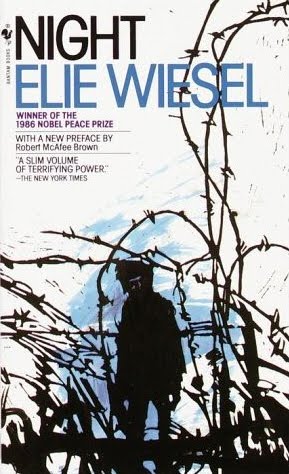
Night - Elie Wiesel


Night is a simple, straightforward memoir of Elie's experiences during WWII. He grew up in Hungary, and relates his experiences relating to the Nazi invasion, and his family and neighbors being forcefully relocated first to the ghetto, and then to various concentration camps.

His story, like all stories from the Holocaust, is tragic and inspiring at the same time. He and his father are separated from his mother and sister early on, and he expresses that the two are each other's strength through the remainder of their experiences.

This is a short (just over 100 pages) book describing more factually than in detail what millions experienced in the 1940s.

Monday, May 31, 2010

The Female Brain - Laura Brizendine


This is an excellent book which I think should be read by females and males alike. It's companion, The Male Brain, was recently released and I plan to read that soon. Both books are written in a very accessible style, and both emphasize the effects hormones have on making women unique from men or vice versa.

The Female Brain talks through the development of the female brain from conception through old age. With my Early Childhood Education background, those chapters particularly stuck out to me, but I would recommend that if nothing else, you read the chapter which applies to your current age (for women) or the current age of your significant other (for men).

The Chapter on the Mommy Brain (all the changes that occur in the brain for both biological and adoptive mothers) was especially fascinating. I have heard a lot of moms say their brains when to mush while they were pregnant or when they brought the baby home, and their are biological causes and reasons for that.

The book is broken up into the following chapters and appendices:

What Makes Us Women
The Birth of the Female Brain
Teen Girl Brain
Love and Trust
Sex
The Mommy Brain
Emotion: The Feeling Brain
The Mature Female Brain
The Future of the Female Brain
Hormone Therapy
Sexual Orientation
Postpartum Depression

By reading this book, I gained a great deal of insight into myself and many of the women I know at all stages of life.

Here are a few things that stood out to me:

-Girls brains are ready for emotional connection at birth. In general, infant girls are more skilled at gazing at people and reading emotions. This ability for mutual face gazing and eye contact increases 400% in the first 3 months of life, while this ability does not increase at all for infant boys in the same time period.

-Girls seek approval in facial expressions. They do not tolerate flat faces and will keep trying to elicit an expression. Thus, if a mother is depressed, her daughter will think her straight expression is a form of rejection of the daughter's self.

-Girls can hear more vocal tones than boys, which makes it easier for them to obey instructions and heed warnings.

-Girls talk to see if they are being listened to and they use this information to determine if others take them seriously.

-Girls calm more easily than boys because they can "absorb" their caregivers emotions and empathize with him/her.

-Infantile puberty lasts 24 months for girls (9 mo. for boys) and bathes the brain in estrogen which makes girls emotionally adept and into caregiving even as toddlers.

-"The 'nervous system environment" a girl absorbs during her first two years becomes a view of reality that will affect her for the rest of her life." Even being raised by the same parents, 2 girls born at different times could absorb nurturing if born in good times or fear if born in unsettling times, thus shaping their world views. "If you're a mom-t0-be carrying a female fetus, take it easy so your daughter will be able to relax." (p. 20)

-When teenage girls talk, it increases the intimacy of their relationships which releases dopamine in the brain (pleasurable) making the reward for talking with friends even greater, thus encouraging them to keep talking.

-Women's self-image is based largely on the quality of their relationships.

-Fear of conflict and end of relationships can make girls willing to sacrifice anything in order to maintain a relationship.

There were plenty of other interesting things in the book. There are some things in the book with which I completely agree and others of which I am skeptical. I recommend you take a look at it to better understand yourself and the women around you.